
Do You Need a Battery Backup for Your Sump Pump?
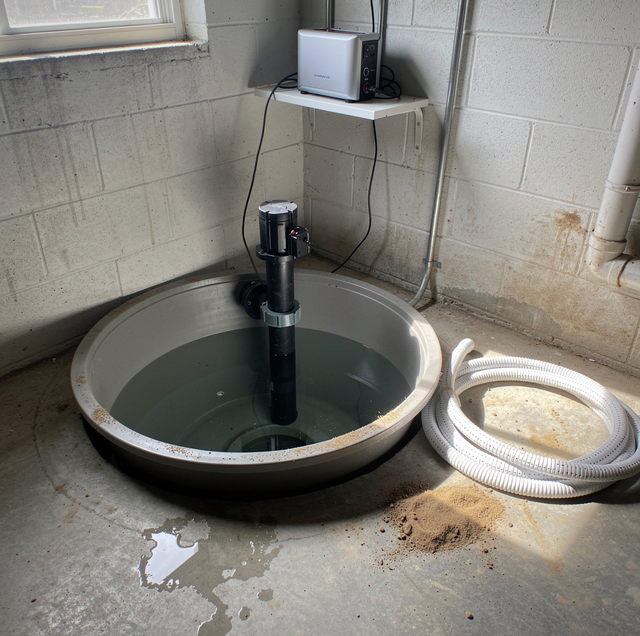
A sump or transfer pump only does its job as long as it has power reaching the motor. That single fact explains why basement flooding and sump pump failure show up together in the same weather event so often: heavy rain and rising groundwater are exactly the conditions most likely to knock out electrical service, whether from a fallen line, a tripped breaker overloaded by other equipment, or a utility-side outage. The pump that's needed most is frequently the one that loses power at the worst possible moment. The real decision isn't whether backup power sounds like a good idea. It's which type of backup actually keeps the basin from overflowing during the specific length and type of outage a property is likely to see.
What actually happens the moment power fails
A standard sump or transfer pump's float switch has no way to call for help once the motor stops responding to it. Water keeps entering the basin from groundwater or drainage tile at whatever rate the storm produces, and without the primary pump running, the basin fills at its natural rate until it overflows onto the floor. The gap between "power went out" and "basement got wet" is often measured in hours, not days, particularly on a property with a high water table or heavy clay soil that quickly sheds rainfall into drainage tile. That narrow window is why backup systems are built to respond automatically and immediately, without anyone needing to be home to notice the outage.
Comparing the backup options
| Backup type | How it actually works | Typical runtime | Best fit |
|---|---|---|---|
| Battery backup (deep-cycle battery + inverter or DC pump) | Stores electrical energy in a battery, switches on automatically when primary power is lost | Several hours of intermittent pumping; less under continuous heavy inflow | Short-to-medium outages, properties without reliable municipal water pressure |
| Water-powered backup | Uses municipal water line pressure to drive an ejector pump, no electricity required | Runs as long as municipal water pressure holds | Properties with strong, reliable municipal water pressure and frequent long outages |
| Standby generator | Automatically starts an engine-driven generator to restore power to the whole primary system | Runs for as long as fuel supply lasts | Properties wanting whole-home backup beyond just the sump pump |
| No backup | Primary pump only | None | Not recommended for finished basements or frequent-outage properties |
None of these are mutually exclusive. Many systems combine a battery backup for the first few hours of an outage with a generator that starts automatically once the outage begins, covering both the immediate gap and an extended outage.
Why a water-powered backup isn't free to run
A water-powered backup drives an ejector using the pressure differential of municipal water passing through a venturi, and this process consumes potable water at a fixed ratio, typically about 1 gallon of supply water for every 2 gallons of groundwater ejected. That water use shows up on the municipal water bill for however long the backup runs during an outage. It's a real tradeoff worth understanding before installing one: a water-powered system needs no battery maintenance and no electricity to function, but it isn't running for free, and it depends entirely on municipal water pressure holding steady, which isn't guaranteed during the same storm that caused the power outage in the first place.
Why a battery backup usually runs a separate, smaller pump
Most battery backup systems aren't sized to run a property's full-capacity primary pump; they pair with a smaller, lower-draw pump designed for the reduced power that a battery and inverter can sustainably supply. That's a deliberate design choice, not a limitation to work around. A primary pump handling continuous heavy inflow can draw enough current that a battery, even a large deep-cycle marine or AGM unit, would drain in well under an hour trying to run it directly. The smaller backup pump trades some pumping capacity for hours of runtime instead of minutes, which matches what a battery backup is actually meant to cover: enough capacity to keep a basin from overflowing until either power returns or a generator picks up the load.
Sizing backup runtime to your basin's fill rate
Deciding how much backup runtime a property actually needs starts with a basin-specific number: how fast the sump pit fills once the primary pump stops, measured in inches per minute during a moderate rain event. A basin that fills slowly, because the surrounding soil drains well or the drainage tile feeding it carries a modest flow, can tolerate a shorter-runtime backup without much risk. A basin that fills quickly, common in heavy clay soil or a property with extensive foundation drain tile feeding a single pit, needs either a higher-capacity battery backup or a water-powered system that isn't limited by stored energy at all. This number is worth timing directly rather than assuming from the pump's rated capacity alone, since fill rate depends on the drainage system feeding the pit, not just the pump moving water out of it.
Storms aren't the only reason power fails
Power outages tied to severe weather get the most attention, but electrical service interruptions happen year-round for reasons unrelated to storms: a tripped breaker due to an overloaded circuit, utility equipment failure, or scheduled maintenance outages. A property that only considers backup power during storm season is planning around the highest-visibility risk while ignoring the outages that happen the rest of the year for entirely different reasons. Backup systems sized and maintained as permanent equipment, not seasonal add-ons, cover both categories without requiring anyone to remember to activate anything before a forecasted storm.
A simple framework for deciding which backup fits
Three questions narrow the decision faster than comparing every feature side by side. First: does the property have strong, reliable municipal water pressure, or does it rely on a private well? A well-fed property effectively rules out a water-powered backup, since the same outage that disables the sump pump likely disables the well pump as well. Second: how long do outages typically run in the area, a few hours or, on occasion, multiple days? Short, occasional outages are well served by a battery backup alone; properties that regularly see extended multi-day outages benefit more from pairing a battery backup (for the immediate gap) with a standby generator (for anything longer). Third: how fast does the sump pit actually fill, based on a timed observation during a real rain event? A slow-filling pit gives more margin for a modest battery system; a fast-filling pit justifies the higher upfront investment in a water-powered or generator-backed setup. Running through these three in order, rather than starting with a product's marketing description, points most properties toward the right combination with little guesswork.
A backup that fails silently is worse than no backup at all
A backup system only helps if someone finds out it was engaged or that it failed. A battery that's lost its charge, or a water-powered ejector with a clogged venturi, can sit ready-looking on the wall for months without anyone noticing it wouldn't actually respond during the next outage. Pairing any backup system with a standalone water-level alarm, a battery-powered sensor mounted above the normal pit water line that sounds when the level rises further than expected, closes that gap. Some backup controllers now include a low-battery or system-fault signal that reports over a home's Wi-Fi network, which matters most for a vacation property or a basement that isn't checked daily, since the alert reaches someone even when nobody is standing near the pit to hear a local alarm.
Frequently Asked Questions
Runtime depends heavily on battery type and how continuously the pump is cycling; a well-maintained deep-cycle marine or AGM battery paired with a dedicated backup pump commonly provides somewhere in the range of 4 to 10 hours of intermittent operation, but that number drops sharply, sometimes to under two hours, if the basin is receiving continuous heavy inflow that keeps the backup pump running nearly nonstop rather than cycling on and off.
No, in almost every case. A water-powered ejector depends on steady municipal water line pressure to drive it, and a well system relies on its own electric pump to generate that pressure in the first place; if the same power outage that disabled the primary sump pump also took out the well pump, there would be no water pressure available to run a water-powered backup. The one exception is a property with a standby generator wired to the well pump: once the generator restores power there, water pressure comes back too, and a water-powered backup could technically resume working, though at that point the generator has already restored the primary sump pump as well, which makes the water-powered option redundant on well-fed properties either way. For practical purposes, well-fed properties should plan around battery backup, generator backup, or both.
Not entirely. Automatic standby generators typically take somewhere between 10 and 30 seconds to detect an outage, start, and complete the transfer switch process, and that gap, while brief, is enough time for a sump pump to miss several pumping cycles during a heavy inflow event; a battery backup bridges that specific gap since it engages instantly rather than waiting for an engine to start.
Deep-cycle batteries used in sump backup systems typically hold a reliable charge for roughly 3 to 5 years before capacity degrades enough to matter, and manufacturers generally recommend testing the full system, not just checking a charge indicator light, at least twice a year by manually triggering the float switch and confirming the backup pump engages and moves water.
In most cases, a battery backup system installs alongside an existing primary pump without replacing it, since the backup unit includes its own dedicated pump, battery, and switching mechanism that only activates when the primary loses power; the main compatibility check is basin size and depth, since the backup pump and its float switch need adequate room to operate independently of the primary pump's equipment.
The most common gap isn't the backup pump itself; it's the check valve on the discharge line. A worn or improperly installed check valve lets water that's already been pumped out flow back down into the basin between cycles, which can make even a correctly functioning backup pump appear to be losing the fight against rising water when the real issue is backflow rather than insufficient pumping capacity.
Backup power for a sump or transfer pump only matters at the exact moment it's least convenient to discover it isn't working, so the decision is worth making and testing well before the next outage rather than during it.
Get your sump or transfer pump backed up before the next outage catches it off guard - a technician can size a battery or water-powered backup to your basin and inflow rate. Pump Repair Services serves Apopka and the surrounding Central Florida area. Call (407) 625-5499.
