
Water Hammer in a Well System: Four Sounds, Four Fixes
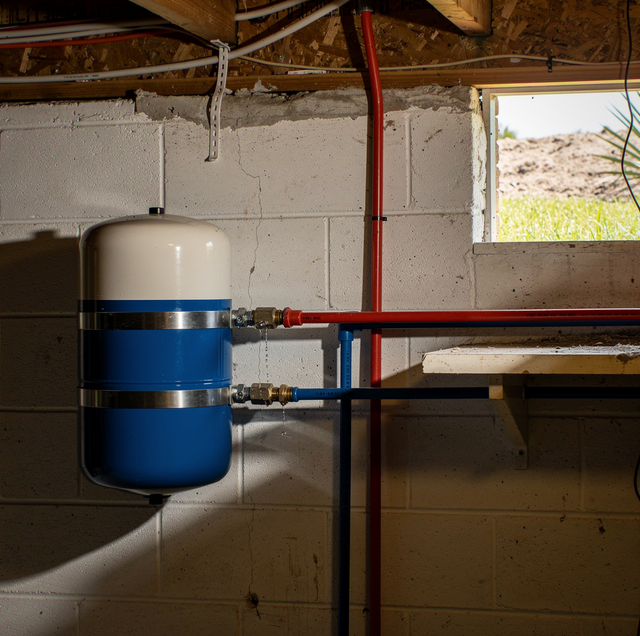
Turn off the kitchen faucet fast, and the pipes in the wall answer back with a single hard knock. A gallon or two of water was moving through that line a second before you closed the valve, carrying real momentum that doesn't disappear the instant water stops moving; it has to go somewhere. On a well system, that principle shows up in more than one disguise, and the causes don't share a single fix. Four different mechanisms produce a bang, rattle, or knock in a well system's plumbing, and treating the wrong one leaves the real problem running underneath whatever just got fixed.
Why a Moving Column of Water Turns Into a Bang
Water moving through a pipe has mass and velocity; mass times velocity equals momentum. Shut a valve or a check valve seat in a fraction of a second, and that moving column has nowhere to go; it decelerates almost instantly, and the kinetic energy converts into a pressure spike that travels back up the line at close to the speed of sound in water. In rigid metal pipe, that works out to roughly 4,000 to 4,500 feet per second; flexible plastic pipe, such as PEX, carries the pulse substantially more slowly because the pipe wall stretches under the spike rather than holding it. That pulse slams into the closed valve, rebounds toward the source, and hits every elbow, tee, and loose hanger hard enough to produce an audible knock. A slow-closing gate valve produces a mild thump or nothing at all; a fast-acting solenoid valve on an appliance can produce a spike several times higher than the line's static pressure. That's the physics behind a bang. Not every noise in a well system's plumbing shares this cause, though, and the fix for one is often useless, or wrong, for another.
True Water Hammer Is a Single Sharp Report at the Instant of Shutoff
The clearest fingerprint of true water hammer is timing: one loud knock that lands at the exact moment a valve shuts, not before and not after. A washing machine's solenoid valve, an icemaker fill valve, or a quick-turn ball valve at a hose bib is the usual trigger, because it closes in a fraction of a second rather than easing shut like a standard fixture valve. This happens on well systems and municipal systems alike; the mechanism doesn't care where the water came from, only how fast it stopped moving. What makes it easy to isolate is that it's tied to one action: run the fixture, close it, and the bang follows within a beat. If closing a specific faucet or appliance valve reliably produces one distinct knock, that fixture's fast closure is the trigger, not the well system as a whole.
A Waterlogged Pressure Tank Turns Every Pump Start Into a Shock
On a well system, the pressure tank does a second job beyond storing water: the compressed air above its bladder or diaphragm cushions the pulse every time the pump kicks on or shuts off, so it never reaches the house plumbing as a bang. When that tank loses its air charge, through a slow leak at the Schrader valve or a failed bladder that lets air dissolve into the water, it fills mostly with water and has nothing left to compress. The tank is waterlogged, and the exact reason a bladder or Schrader valve fails is a separate diagnosis with its own set of checks.
What matters here is the sound: with no cushion left, every single pump start and every pump stop transmits almost directly into the plumbing, so instead of one occasional knock, the system bangs on a rhythm tied to the pump cycling rather than to any one fixture.
A waterlogged tank also holds far less usable water before the pressure switch calls for another cycle, so the pump starts and stops more often than it should. That's short-cycling, and each extra start is another chance to bang. The two problems compound: less cushion makes each shock land harder, and more frequent cycling means more of them happen per hour. Of these four mechanisms, a waterlogged tank is the most specific to a well system, because it is the only one tied to the pump's cycle rather than to a fixture someone opened and closed.
The air pre-charge is set by whoever commissions the tank, about 2 psi below the pressure switch's cut-in, checked at the Schrader valve with the tank drained. Change that switch setting and the pre-charge has to be reset to match.
Thermal Movement and Loose Runs Produce a Rattle, Not a Report
Not every noise in the wall is a pressure event. PEX and copper both expand slightly as hot water moves through them and contract again as the line cools, and a run that isn't fully secured to the framing will tick, creak, or rattle as it slides against a joist or a loose strap during that expansion and contraction. The telling difference from true hammer is timing: this noise shows up only after the flow stops, as the pipe cools and pulls back toward its resting length, rather than at the exact instant a valve shuts. It's also usually a softer, more drawn-out sound than a single sharp knock, because nothing is decelerating a moving column of water; the pipe itself is simply moving against whatever is touching it. Rigid metal pipe tends to carry this vibration more audibly through a house's framing than PEX, which flexes enough to absorb some of the motion on its own. A pipe strap re-secured to the joist, or foam pipe insulation added where a line crosses a stud, resolves this kind of noise without touching the well system, the pressure tank, or anything upstream of the wall.
Multiple Check Valves Add Their Own Slam to a Submersible System
Some submersible well pump installations carry more than one check valve: one set just above the pump on the drop pipe to hold the column and keep it from spinning the impeller backward when the motor stops, and a second higher up the drop pipe or near the tank to protect the switch from backflow. When the pump shuts off, the reversing water column slams the nearest check valve shut first. The momentum still held between the two valves then slams the second an instant later, producing two closely spaced knocks instead of one clean report. A jet pump, by contrast, typically runs with a single check valve, so this rapid double-bang pattern is specific to submersible setups with more than one check in the line, and it happens every time the pump cycles rather than being tied to any fixture in the house.
Placement adds a second way the same setup can slam itself. A common rule of thumb puts the upper check valve within about 25 feet of the pumping water level; set well above that, and the column above it can drain back down enough to open an air gap while the pump is off. On restart, that section accelerates through open space before it meets resistance again, and the impact can land harder than the ordinary double-check pattern above.
Why the Well Side Hits Harder, and the Order That Actually Fixes It
A municipal connection sits behind a large main and a utility pressure-regulating system with room to absorb a surge before it reaches a single house. A well system has no such buffer: the pump cycles directly against the home's own plumbing, so whatever pulse it produces has nowhere to dissipate except into that house's own pipes, fittings, and fixtures. That's part of why hammer on a well system repeats on a schedule tied to the pump, rather than showing up once in a while.
Repeated pressure pulses take a real toll over years rather than months. Soldered joints and threaded fittings work slightly loose with each shock and can develop a slow weep long before they fail outright. The pressure switch absorbs it too: its electrical contacts pit and its internal diaphragm fatigues with every pulse it senses, shortening the switch's working life well below what steady, cushioned pressure would allow. Inside the pump itself, the thrust bearing carries the axial load of the impeller stack every time the motor starts, and an extra shock load on top of an already-short cycle adds wear that a well-cushioned system never asks that bearing to handle.
A pressure switch carries the pump's full line voltage across its contacts, often 240 volts on a submersible system. Cut power at the breaker before removing the cover to inspect pitted contacts - never test it with the circuit live.
The repair order matters because treating the wrong stage first just adds a part without fixing the noise. Start with the tank: recharge the air if the bladder is intact, or replace the tank if it's failed, since a properly cushioned tank eliminates most well-specific hammer on its own. Next, confirm the short-cycling has stopped, with the pump running a full cycle rather than starting and stopping in bursts. Only after those two steps, if a knock still shows up tied to one fast-closing fixture, does a water hammer arrestor at that fixture make sense; it absorbs the shock of a single fast closure and isn't built to replace the cushioning job an entire tank is supposed to do. A knock that traces instead to the well side, such as a check-valve pattern, is a well-service adjustment rather than something a fixture-side arrestor reaches, and installing one on a tank that's still waterlogged just muffles a symptom the tank itself should be absorbing.
Frequently Asked Questions
A water hammer arrestor is a small capped cylinder, usually a few inches long, with a sealed air chamber or a piston inside that compresses to absorb a pressure spike. It installs close to the fixture that's actually slamming, typically threaded into the supply line behind a washing machine box or under a sink, not at the pressure tank or the wellhead, because it only protects the run downstream of where it sits.
There's no single number that fits every well system; it depends on the pump's horsepower and design. What's constant is that every submersible motor is rated for a maximum number of daily starts, listed on its nameplate or spec sheet, set by the manufacturer to limit heat in the windings and shock loading on the thrust bearing. A tank forcing the pump past that daily limit is doing more than making noise.
It's possible, though less common than an in-house cause. A drop pipe that isn't properly centered or clamped in the well casing can shift and tap the casing wall as the water column starts and stops with the pump, producing a knock felt at the wellhead rather than traced to any indoor fixture. This is a mechanical, downhole version of the same momentum problem, and a well-service diagnosis rather than something to chase through the house's plumbing.
Not on its own. Tank size mainly sets how much usable water, the drawdown, the system delivers between pump cycles, and a larger tank simply means fewer cycles per hour under the same demand. The cushioning that actually prevents hammer comes from the air pre-charge being correct relative to the pump's cut-in pressure, not from the tank's total volume. A large tank with a failed bladder hammers exactly as hard as a small one in the same condition.
There are two broad styles, and the difference is in how the air is kept where it belongs. A bladder tank uses a rubber bladder to hold the air charge permanently separate from the water. Older galvanized tanks instead rely on a separate air volume control valve to reinject air lost through absorption; when that control fails, the tank waterlogs the same way a ruptured bladder does, just from a different point of failure. Either style produces the same hammer pattern once the air charge is gone.
It doesn't rule the tank out on its own, but there's a test that settles it. Close that fixture's own stop valve at the wall so no water can reach it, then run a tub or a hose somewhere else in the house long enough to make the pump start and stop two or three times. The banging that continues while that bathroom sits isolated is coming from upstream.
Schedule a well system diagnostic - a technician will check the pressure tank's air charge, the pump's cycling pattern, and the check valves before recommending a fix. Pump Repair Services serves Apopka and the surrounding Central Florida area. Call (407) 809-8805.
