
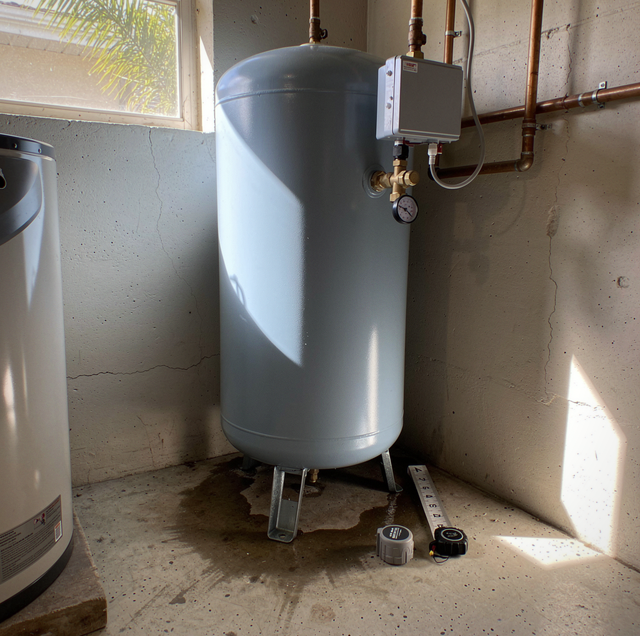
You turn on the kitchen tap and get a short gush, a sputter, then nothing. You walk out to the pressure tank and listen. No hum, no click, no motor sound of any kind.
That silence narrows the search. Either no power reaches the pump, the pressure switch never calls for it, or the call dies somewhere between the switch and the motor down the well. A pump that hums, one that runs without delivering water, or one that quits and comes back after resting, has a different fault with its own causes. The steps below follow the order a technician rules things out, from the panel down to the motor, and say what you can safely observe at each one. Your hands-on part ends at the breaker and the gauge. Everything past them runs at line voltage, 240 volts on most well pumps, and stays closed until the technician arrives.
Step 1: Look at the Breaker, and Reset It Only Once
If every light in the house is out, the pump is waiting on the utility and nothing at the well needs checking yet. Otherwise, find the pump's two-pole breaker in the main panel, and check for a separate disconnect switch near the pressure tank or on a wall by the well. A breaker handle sitting in the middle position or pushed toward off has tripped. A disconnect someone switched off during a plumbing repair cuts power just as completely.
If the breaker has tripped, push it fully off, then back on, one time. Open a faucet and listen. A pump that starts and keeps running may have had a single event, still worth mentioning when you book the visit. If the breaker trips again, leave it off. A second trip says the fault is still there, and each further reset sends current back into it.
A breaker that never moved tells you something too. Whatever stopped the pump did not pull enough current to trip the panel, which points away from a short and toward a part that has opened the circuit: a switch that will not close, a burnt contact, or a broken wire.
Step 2: Read the Pressure Gauge Against the Cut-In
The gauge on or beside the pressure tank tells you whether the pump should be running at all. The pressure switch operates based on two numbers. At the cut-in pressure, the lower number, it closes and starts the pump. At the higher cut-out pressure, it opens and stops it. Household switches are set in pairs such as 30/50 or 40/60 psi, 20 psi apart. If you do not know your pair, write down the reading anyway; the technician can read the setting off the switch.
With every faucet closed, read the needle:
- Above the cut-in: The switch has no reason to start the pump, so the silence is expected. A dry tap with pressure on the gauge means water is held up between the tank and the faucet, which is a plumbing or treatment-equipment problem rather than a pump that won't start.
- At or below the cut-in: The switch should have closed by now. The pump is being asked to run but is not responding, so the fault lies in the switch or somewhere beyond it.
- At zero: The tank has emptied, which fits a pump that stopped some time ago while the house kept drawing water. A needle resting on zero can also indicate a failed gauge, which is one reason the technician confirms pressure with a test gauge of their own.
Photograph the gauge before anyone opens another faucet, then again after a tap has run for a minute. Two readings, with times attached, show the technician whether the pressure is holding, falling, or already gone before any test begins.
Step 3: Listen at the Pressure Switch, but Leave the Cover On
The pressure switch is the small box mounted on a short length of pipe near the tank, with wires running in from the panel and out toward the pump. With the gauge at or below the cut-in, stand near it while someone runs a faucet in the house. A working switch closes its contacts with a sharp, audible click.
- A click with no pump sound: The switch did its job and passed power along. The fault lies past it, at the control box, along the wiring to the well, or in the motor.
- No click at all: The switch becomes the prime suspect. Its contacts arc a little every time they open under load, and a set that has burned or pitted through will not carry current even when the mechanism moves.
From the outside, look for scorch marks around the cover seams, melted or discolored plastic, and a burnt smell, each a sign of arcing inside. Skip the trick of tapping the housing with a screwdriver handle to jar the contacts closed. It puts your hand beside live terminals, and when it works, it only hides a switch that has already failed.
A pressure switch and control box carry line voltage to their terminals even while the pump sits silent, and the switch can snap closed without warning. Keep both covers on and leave the opening and testing to the pump technician.
Step 4: Find the Control Box on a Three-Wire Pump
A submersible pump wired with three conductors plus a ground has a control box on the wall near the tank or the switch, housing the components that start the motor. A two-wire pump has no box at the surface, so on that type the search goes straight from the switch to the well. An above-ground jet pump keeps its motor in plain view, where a technician can test it directly.
Without opening a box, you can count the wires leaving it toward the well and look for a scorched or discolored cover, a cracked housing, or water stains around the seams.
On a silent pump, the technician's question at the box is simple: does line voltage arrive, and does it leave toward the well? Power in, nothing out, places the fault inside the box. Power passing through sends the search down the well.
Step 5: Weigh a Recent Storm or Outage
Before the search goes underground, think back over the last day or two. A thunderstorm, a nearby lightning strike, or a power outage just before the pump went quiet changes where the technician looks first. Storm damage affects the controls as well as the motor, so a pump that fell silent the night the lights flickered calls for testing every part between the panel and the well. One burned part found after a storm does not clear the others.
That kind of damage can land at any time of year, so a calm, dry stretch of weather is no reason to rule it out if the power went off during the week. The reverse also holds. On a property where lightning and outages seldom reach the equipment, a surge is the less likely explanation, and the checks in the other steps carry the search.
Step 6: The Motor and Drop Cable down the Well
If power leaves the surface controls and the pump stays silent, the break sits out of sight: the cable run to the wellhead, the drop cable hanging down the well beside the drop pipe, the waterproof splice where that cable joins the motor leads, and the motor windings themselves. A splice can let water in and corrode through. The cable jacket can chafe against the casing, since the pump twists slightly each time it starts. A winding can burn open. Any one of those leaves the motor with no complete path for current, which is why it makes no sound.
Resistance readings across the motor leads at the surface, compared with the maker's published values for that motor, indicate whether the circuit through the cable and windings is complete or open. An open reading places the fault down the well, while readings that match the published values send the search back up to the controls. Only after the readings point below ground does it make sense to pull the pump, because pulling means lifting the motor, the pump end, the drop pipe and the cable out of the casing together.
What to Tell the Technician
Before you phone, gather:
- When it stopped: The time the water quit, and what was running then.
- What you heard: Silence, a click at the switch, a hum, or a buzz.
- The breaker: Its position when you found it, whether you reset it, and what happened after that one reset.
- The gauge: The reading with no water running, plus the cut-in and cut-out pair if you know it.
- Storms and outages: Anything in the day or two before the silence, whether power flickered or went out, and whether other equipment failed the same night.
- The equipment: Submersible or jet, the number of wires at the control box if there is one, and roughly how old the system is.
- What you saw or smelled: Scorch marks, melted plastic, or a burnt smell at the switch or box.
Once your notes are down, switch the pump breaker off and leave it off. A burnt contact or a damaged splice can make contact again on its own, and a circuit that is off stays predictable while someone works around the tank and the wellhead.
Frequently Asked Questions
That lever marks a low-pressure cutoff switch. When pressure falls below the cut-in, as it can when the well runs short or a pipe breaks, this type of switch opens its contacts and holds them open until someone resets it by hand. Resetting means holding the lever while the pump builds pressure, putting a hand beside the live terminals; whatever dropped the pressure still needs to be found. Leave both jobs to the technician.
Yes. Ants and other small insects nest inside switch housings, and a packed nest can hold the contacts apart so the switch never closes, or bridge the terminals and burn them. A trail of ants around the cover is worth mentioning. The repair means cleaning or replacing the switch and closing off the gaps that let them in.
A pump wired for 240 volts requires a generator with a 240-volt output; a unit with only 120-volt outlets cannot run it. The generator also has to cover the motor's starting draw, which exceeds the running figure on the nameplate, so a generator sized to the running figure alone can stall at start. Feeding house wiring from a generator also needs a transfer switch or interlock installed by an electrician, so power cannot flow back onto the utility line.
Some systems add a pump protection control near the pressure switch that monitors the motor's current and shuts the pump off when it detects dry running or an overload. After a shutdown, it waits out a restart delay before trying again, and on some units that delay is adjustable from minutes to hours. A silent pump behind one may be waiting on its timer. Note which indicator light is on, since the trip itself says the well or pump did something worth checking.
Some installations feed the pump through a fused disconnect, and a blown fuse gives no visible sign, unlike a moved breaker handle. A 240-volt circuit runs through two fuses, one on each leg, so a single blown fuse leaves the pump without the supply it needs to start while the panel breaker looks normal. Testing cartridge fuses means working inside a live disconnect, so the technician handles it, replaces a blown fuse with the same rating, and determines why it blew.
Yes. The cable between the house and a submersible wellhead runs through a buried trench, and a fence post, an irrigation repair, a tree planting, or trenching for another utility can nick or sever it. A cut cable leaves every part at the surface working while the motor gets nothing, and a nicked jacket can let water in and fail long after the digging. If anyone has dug between the house and the well, say so, and the technician can check that run before anything comes out of the well.
Get a silent well pump traced from the panel to the motor - every point the power has to pass is tested until the dead link turns up. Pump Repair Services serves Apopka and the surrounding Central Florida area. Call (407) 625-5499.