
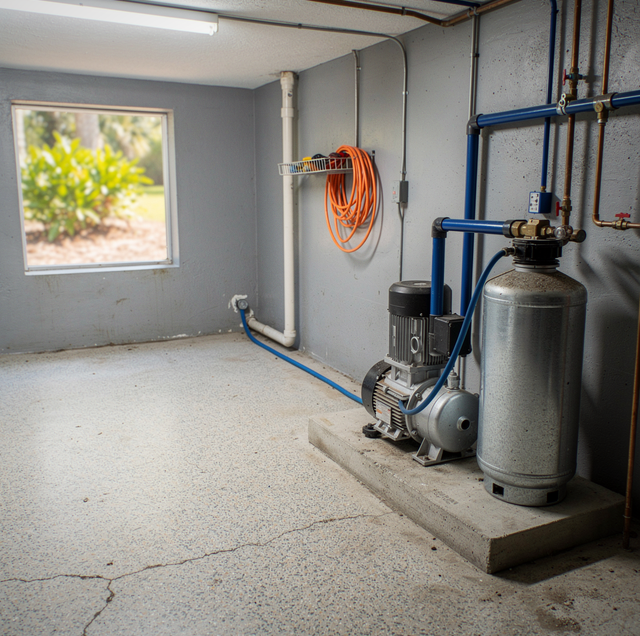
Whether a well pump pulls water from above or pushes it from below sets how far down it can reach, whether it needs priming, where the noise ends up, and what a repair involves. A jet pump sits at the surface and relies on suction to lift water a pipe. A submersible pump sits down in the well and shoves water toward the surface instead. Both land water at the same faucet, but the physics behind each one sets a hard boundary on which wells they can serve, and that boundary determines which pump belongs on a given well.
The table compares the two pump types from where each sits to how each fails.
| Point | Jet Pump | Submersible Pump |
|---|---|---|
| Where it sits | Above ground, in a utility room, basement, or well house | Hung in the well casing, below the water it pumps |
| How it moves water | Pulls water up by suction, helped by an ejector | Pushes water up under positive pressure from stacked impellers |
| Well depths it suits | Shallow-well jet where the water sits within about 25 feet of lift; deep-well jet for deeper water, with its ejector set down in the well | Shallow or deep wells, including water too far down for a jet pump's reach |
| Priming | Must stay flooded through a sealed suction line or it loses prime | Never loses prime while its intake stays under water |
| Noise | Audible motor and cycling at the pump's location | Silent at the surface; the sound stays down the well |
| Service access | Shallow-well jet: seals, ejector, and impeller at the pump. Deep-well jet: the ejector hangs in the well | Requires pulling the pump and drop pipe out of the well |
| How each fails | Air leaks, a worn ejector nozzle, a failing foot or check valve, cavitation from a starved impeller | Motor or bearing wear, cable insulation breakdown, impeller wear from grit |
The Suction Ceiling on a Jet Pump
A jet pump stays above ground and lifts water by suction, and suction has a ceiling: a shallow-well jet serves water within about 25 feet of lift. For deeper water, the deep-well version sets its ejector down in the well while the motor and impeller stay at the surface, and that is the only way a jet pump reaches past the shallow limit. Either version needs its suction side full of water before it can lift anything.
The deep-well setup also carries a running cost that the shallow one avoids: part of the water it lifts returns down the well to drive the ejector, so the motor works on recirculated water as well as on every gallon that reaches the tap.
How a Submersible Pump Pushes Water
A submersible pump flips the setup: the pump and motor hang down in the well, at or below the water level, sealed to keep water out of the motor while staying immersed the whole time it runs. Instead of pulling water up from above, the impellers push it. Submersible pumps stack several impeller stages one after another, and each stage adds more pressure to the one before it, building enough push to send water hundreds of feet to the surface if the well demands it.
Because the motor works from inside the water column rather than reaching for it from above, a submersible is not limited by atmospheric suction the way a jet pump is. The well's depth determines how many stages the pump needs and how much power the motor must deliver, not whether the pump can reach the water at all. That difference is also why a submersible has no suction line to lose: water surrounds it before the motor ever turns on. It also means every gallon the impellers move goes straight up the drop pipe with nothing sent back down the well, so the motor is not doing extra work recirculating water the way a deep-well jet's ejector does.
Well Depth and Water Level Decide the Choice
Depth sets the boundary between the two pump types, and the depth that counts is how far the water sits below the pump while the pump runs: the static level plus the drawdown, rather than the length of the borehole. A borehole can run well below its water; a deep well with water close to the surface can still fall within a jet pump's reach, while a shallower well whose water drops low under pumping can push a jet pump past its suction limit.
Where the level in the well climbs and drops from one season to the next, that swing can decide whether a shallow-well jet keeps enough suction margin or gets pushed past it. A property whose water remains at a steady depth throughout the year keeps this a settled question. Where the swing is real, a jet pump that primes without trouble in a high-water season can end up straining against its suction limit in a low one, with the drawdown adding to the drop, while a submersible set below the lowest point the water reaches keeps its intake under water through the change.
Priming and Suction Problems
A jet pump depends on a sealed, flooded suction line and a one-way valve that holds it full between runs; a submersible has neither to lose. Finding where a given jet pump loses its prime is a repair question for the pump already in place. For choosing between types, what counts is that a jet pump carries this dependency for as long as it is installed.
A submersible sidesteps that failure mode: with the motor and impellers already underwater, there is no suction line to keep sealed and no prime to lose. The closest thing to a priming problem on a submersible is the water level dropping below the pump intake itself, which starves it of water to move rather than letting air into a line. One safeguard for that case is a dry-run shutoff that stops the motor.
Noise, Space and Access
A jet pump requires floor space and tolerance for its sound: a spot in a utility room, basement, or well house has to fit the pump, the pressure tank sitting nearby, and provide enough clearance to service both. On a shallow-well jet, the ejector, seals, and impeller all sit at the pump, so a technician works standing at the housing without opening the well. A deep-well jet keeps its motor and seals at the surface too, but its ejector hangs in the well on the pipes, and a fault down there means pulling pipe.
A submersible trades that surface footprint for a different cost. There is no pump noise or motor at the surface, and no floor space beyond the wellhead and its pressure tank, since everything that moves water lives down the casing. When it does need attention, that convenience runs the other way: the pump, cable, and drop pipe all have to be pulled up out of the well before a technician can look at any of it, work that takes rigging and time a surface repair never requires.
A well pump runs on line voltage, and its pressure tank holds pressure after the motor stops. Leave priming a jet pump and pulling a submersible to a technician, who shuts off the breaker and first relieves that pressure.
Repair or Swap to the Other Type
A repair stays within the pump type already installed: a failing valve, a worn impeller, or a bad seal gets fixed or replaced on the same jet or submersible setup. A swap becomes worth discussing when the well has changed, such as a pumping level that has settled past a jet pump's reach, or when the owner wants the pump out of the utility space and the casing can take a submersible.
Neither direction is a simple parts swap. Moving from a jet setup to a submersible means running new wiring down the well and sealing the wellhead differently; moving the other way means adding a suction line and priming components a submersible never needed. A technician who has pulled the pump and measured the pumping level can say whether the current pump type still matches what the well is doing now, or whether the well has moved past it.
Frequently Asked Questions
Yes, provided the well casing is wide enough and straight enough to lower a submersible and its drop pipe down the bore. A standard 4-inch submersible needs a casing at least 4 inches in diameter; narrower wells require a 3-inch model. Any bend, dent, or narrowing in an older casing can prevent the pump from going in, even where the water depth would otherwise support it.
Yes. The cable running down to a submersible must be rated for full-time submersion, with waterproof splice kits at every joint. That cable runs the full depth of the pump setting plus the distance to the surface controls, while a jet pump is wired where it sits.
It can sit some distance off, in a pump house or garage, but every foot of horizontal suction pipe and each elbow adds friction that the pump pays for out of its limited suction lift. A long offset shrinks the depth from which the pump can still draw water, and a larger-diameter suction pipe on a long run cuts that loss.
A fitting called a pitless adapter makes that connection underground, at the casing wall below the frost line, so the drop pipe from a submersible, or the suction line on some jet setups, passes through the casing wall instead of up and out through an open wellhead, keeping the well sealed against surface contamination.
A property with a heavy irrigation load can run a separate booster or centrifugal pump dedicated to irrigation zones, sized for the sprinkler system's own flow and pressure needs, rather than asking the primary well pump to double duty; sharing one pump between the house and irrigation can drag household pressure down whenever a zone runs.
Yes. A submersible motor kicks against the drop pipe each time it starts, twisting the pipe slightly. On a plastic drop pipe, a torque arrestor fitted above the pump keeps it centered in the casing, and straps holding the cable to the pipe prevent the cable from dragging against the casing wall.
Bring in a technician to measure your well's pumping level and casing. The visit checks the water depth under pumping, the casing width, and your current setup, and you'll hear clearly whether a jet or submersible pump fits your well now. Pump Repair Services serves Apopka and the surrounding Central Florida area. Call (407) 625-5499.