
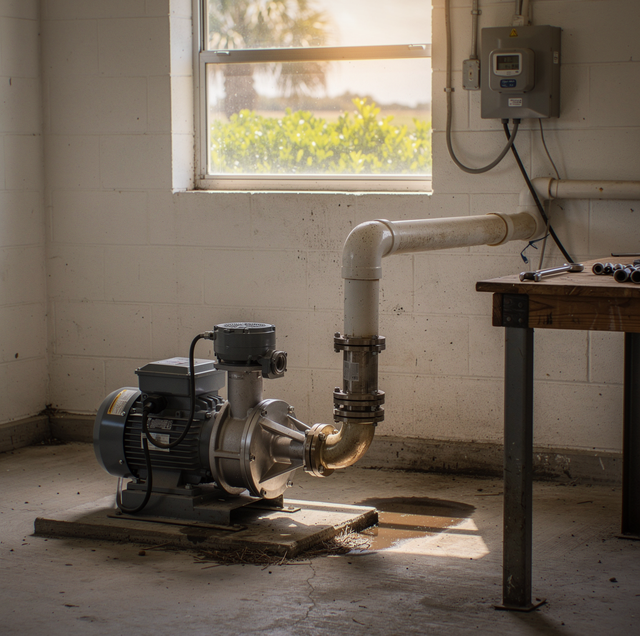
A pump that fails once has a story: a part wore out, a fitting let go, a component finally reached the end of what it could take. A pump that keeps failing has a different story, because whatever gets replaced each time is the casualty, not the cause. A technician sees a failed seal, a tripped motor, or a worn impeller and swaps it, but if the same class of failure recurs after the repair, something upstream of that part is still causing the damage, and the next replacement runs on the same schedule as the last one. On a commercial irrigation system, the pattern across repairs names the fault that a single failure hides.
Each repeat pattern matches the root causes that produce it:
| What keeps repeating | What is behind it |
|---|---|
| The same seal or bearings failing again | A load the part can't outlast: operation off the pump's matched point, or contamination reaching the bearings or seal |
| The motor tripping or burning out again | On a submersible turbine, restricted flow past the motor starving its cooling; a control fault; or run cycles beyond what the motor was built for |
| Impellers wearing out fast | Grit reaching the impeller through a compromised intake, or cavitation from a restricted suction line |
| The pump losing prime after every repair | A suction-side condition the repair never corrected |
| Controls and contactors failing again | Starts in a day beyond what a contactor is rated for, or a control component mismatched to the pump's real load |
A Pump Sized for a Job It Has Outgrown
A pump on a commercial irrigation system was matched to a specific point: a given number of zones, a given run length, a given head count, all drawing water at once or in sequence. Add zones, stretch run times, or route more heads through the same line after installation, and the pump keeps running, but it is now working past the point it was matched to. Operating away from that matched point increases the load on the bearings and the shaft, even though nothing about the pump itself has changed, and the wear shows up first in whichever part is carrying that extra load: the seal, the bearings, or the impeller. A pump that ran without incident for years and then developed a recurring pattern can be traced back to a change made elsewhere on the property, such as added zones or heads.
Suction and Intake Conditions
The intake limits what the pump can deliver no matter how sound the motor and impeller are. A partly blocked intake screen, a strainer packed with sediment or debris, or an intake set too high above or too far from the water source all throttle what reaches the impeller, and starving the impeller that way wears down the vanes while cutting output. An intake with too little water over it can also form a vortex that pulls air down into the pump, and that air breaks up the flow through the impeller and shakes the shaft. Whether the pump can hold its prime is determined by its own mechanism; a restricted intake wears the pump down, cycle after cycle, even while it keeps priming and running.
Running Against Closed or Restricted Discharge
A discharge valve left nearly closed, a check valve stuck partly closed, or scale narrowing the pipe downstream of the pump all force the pump to work against resistance it was not matched to. Pushed off its designed operating point that way, a centrifugal pump recirculates water inside its own casing, and that recirculation generates heat and adds load on the bearings and seal. With the discharge fully closed, all of the motor's work goes into the water trapped in the casing, and that water can heat until it flashes to steam. A pump running against that kind of restriction for an extended stretch can show the same wear pattern as one running with a failing part, which is why checking valve position and downstream restriction comes before assuming a component is simply worn out.
Duty Cycle and the Heat of Long Daily Run Times
Every running hour adds to the cumulative wear on bearings, seals, and windings, and a commercial system's long daily runs add up those hours day after day. A motor that overheats and cuts out under a long draw is its own failure with its own causes; the concern with long run times is the baseline stress every part carries, which brings a bearing already partly worn, or a seal already carrying some wear, to the end of its life on a schedule set by the hours logged.
Power Supply and Control Faults
A pump's motor draws a sharp surge of current at startup, well above what it draws once it is running, and a control system that starts the pump more often than the load calls for multiplies that current spike throughout the day. Supply and control faults impose the same kind of stress on a motor even when nothing is wrong with the pump's mechanical condition. On a system where the irrigation controller's pump start circuit drops out between zones, every pause between stations becomes one more stop and one more start for the motor and its contactor. A repeat pattern that keeps landing on the motor or the controls, rather than on the wet end of the pump, is worth checking there before the pump itself gets opened up.
A control panel or starter can hold live voltage with the pump stopped, and a motor on automatic restart can start with nobody at the switch, posing a shock and entanglement risk. A licensed technician opens the disconnect before any wiring work.
Before anyone goes near the pump, its coupling, or its intake, the pump is shut off at its disconnect. The guards over the shaft and coupling remain in place, and no one reaches into an intake or a wet well while the pump is energized. A pump found running with no water moving is shut off at that disconnect, since the water it is not moving is also the water that carries its heat away.
What a Repair That Holds Looks Like
Replacing the failed part is only half of the repair for a pump caught in a repeating pattern. The other half is checking what has been loading that part beyond what it was built to carry: the intake and discharge conditions, the duty cycle the system is running, and the condition of the controls feeding the motor. A new seal installed on a pump still running against a restricted discharge can fail for the same reason the old one did, because the condition that wore out the first seal never left. Correcting the cause alongside the part is what makes the repair hold.
Frequently Asked Questions
Not on its own. A heavier-duty seal, bearing, or motor can absorb more stress before it fails, but if the discharge is still restricted or the pump is still running past the point at which it was sized, that same stress is still being generated; the upgraded part only takes longer to reach its limit. Fixing the cause stops the pattern; upgrading the part only changes how long it takes to repeat.
It can. Swapping any two supply leads on a three-phase motor reverses its rotation, so a motor reconnected after a repair or wiring work can turn the pump backward with nothing out of place at the panel. A centrifugal pump turning backward still moves some water at reduced pressure and flow, which can pass for a worn impeller, and a new impeller fitted to that pump leaves the output where it was.
Yes. Noting which specific part failed, when it failed, and how the system was running at the time gives a technician something to compare across repairs. A pattern that only shows up when records from separate visits are set side by side is invisible to anyone looking at a single failure on its own.
Yes. Extending a discharge line, or adding elbows or a longer run to reach a new area of the property, changes how much resistance the pump is pushing against, even when the zones and head count downstream have not changed at all. That added friction loss moves the pump away from the point it was matched to, just as surely as a restricted valve does, and it is easy to miss because nothing about the original system looks different.
Yes. A control panel can look intact and still be the source: a connection loosened by vibration, or a contactor sized for a lighter load than the pump draws, can starve or spike the motor without the panel itself ever failing outright. Voltage and current measured at the motor terminals under a running load catch a marginal control fault that a look at the panel misses.
It can if it is not matched to the pump's real load. A drive or soft starter set with the wrong minimum speed or current limit can shut the motor down on a fault, or let the motor run below the speed it needs to stay cool, and because the fault sits in the drive's settings rather than in the motor's windings, a technician swapping motors without checking those settings sees the same failure return.
Retain commercial irrigation pump repair - intake, discharge line, motor and controls on sub-turbine, line-shaft turbine and centrifugal booster pumps. Pump Repair Services serves Apopka and the surrounding Central Florida area. Call (407) 625-5499.