
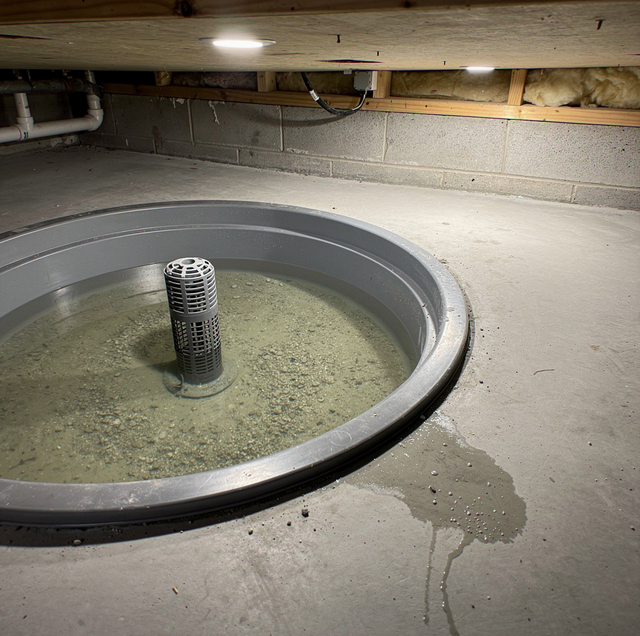
A sump pump that clogs once is not necessarily a warning sign: a stray root hair or a chunk of gravel can slip past the screen on one unlucky cycle, and clearing it settles the matter. A pump that clogs or jams again and again is a different problem, and freeing it one more time does not answer it. Something in or around the pit keeps delivering more solid material to the intake than the pit can let settle and the pump can pass through, and until that source is found, every cleared jam is only a pause before the next one. The useful question is what keeps sending debris its way in the first place.
Matching the source of the debris to the pattern it leaves narrows the search quickly. Each source that sends debris toward a sump or transfer pump leaves its own sign in the pit and at the pump:
| Source | What It Sends Toward the Pump | Sign to Watch For |
|---|---|---|
| A pit with no liner, or a liner that has cracked | Loose soil sheds continuously into standing water | Cloudy or gritty water even between pump cycles |
| An open pit with no lid | Leaves, mulch, and yard debris fall in from above | Visible debris matted on the intake screen |
| The pump sitting in settled silt on the pit floor | Fine sediment is pulled straight into the intake | A hum with weak or no flow, a silt-caked housing |
| Sediment carried in by drain tile or general inflow | Grit arrives with every fill cycle, not from the pit itself | Debris reappears after a cleanout |
| A laundry or other discharge line sharing the pit | Lint and fibers mat over the intake screen | A felt-like mat rather than loose grit |
| A float fouled by debris | Silt on the rod or hinge slows or blocks its motion | The pump starts late, runs erratically, or misses cycles |
The Pit Itself: Where Soil Gets In
A sump pit is a plastic or concrete liner set into the floor, which separates the pump and its standing water from the surrounding soil. An unlined pit, or a liner that has cracked, shifted, or come apart at a seam, allows native soil to migrate through the gap as water rises and falls around it. Unlike a single chunk of debris, this source never runs out. A compromised liner sheds a steady supply of fine soil into the water with every cycle, so clearing the intake screen only buys time until the next batch settles behind it.
Some pit liners are perforated to let groundwater in from the surrounding soil, and a layer of washed gravel or filter fabric around the outside of the liner keeps that soil from riding in through the openings with the water.
Where the Pump Sits and What Its Screen Catches
A submersible pump resting directly on the pit floor draws its water from exactly where sediment concentrates, since anything heavier than water settles to the bottom between cycles. A properly set unit stands on a raised base or a bed of clean gravel so the intake draws from water above the settled layer rather than within it; a pump that has shifted off its base, or was never set on one, can draw in silt on each cycle instead of clean water. The intake screen is the last barrier before that grit can reach the pump's moving parts, and a screen packed with fine sediment leaves the pump humming and running while it moves noticeably less water than it should.
A sump pit puts standing water beside a live pump, a shock hazard, so a jam is never cleared by hand while the pump is powered. A technician isolates the circuit and wears gloves, since pit water can carry sewage or mold.
What the Inflow Brings with It
Not all the water reaching the pit comes in through the floor around it. A share of it arrives through drain tile or a foundation drainage run built to route groundwater into the pit, and that inflow carries whatever the tile itself has picked up along its length: fine sand, silt, and grit that has worked in through small gaps or perforations. Because this sediment rides in with every fill cycle rather than sitting in the pit on its own, cleaning the pit alone does not stop it. Debris from this source keeps returning after a cleanout even where the liner is sound and a lid is in place, because the tile keeps feeding it in with every fill.
A Float Fouled by Debris
The float switch senses water level, and whether it rides a tether, slides on a guide rod, or reads through a sealed pressure port depends on a clear range of motion to do that accurately. Debris and settled silt do not have to jam a float outright to cause trouble. A coating of sludge on a hinge or a rod can slow its response enough that the pump starts late, runs longer than it needs to, or misses a cycle, symptoms that can look like a wiring or supply problem before anyone traces them back to a dirty float. A float that has jammed fully in the on position is a related but separate failure, since debris there is stopping the switch rather than only slowing it.
Matching the Pump to What the Pit Carries
Not every sump pump is built to pass the same debris load. A standard sump pump is sized to move clear-to-lightly-sedimented water, while a pump built for a higher solids load is designed with a wider internal passage to let small debris pass rather than catch inside. When a pit consistently carries fine grit, matting lint, or organic debris, a technician sizing a replacement weighs that solids load the same way flow and lift are weighed, since a pump swapped in without that match will repeat the clogging under a new pump instead of solving it.
Closing Off the Source at the Pit
A visit aimed at recurring clogging works from the source outward rather than only freeing the pump one more time. That starts with a cleanout of the pit itself, clearing settled silt and matted debris from the floor and the intake area. A lid is fitted, and a liner is replaced where the pit calls for it, closing off that source rather than letting it refill the pit again. The pump itself gets reset on a proper base if it has settled into the silt layer, and any float that has slowed or stuck due to fouling gets cleaned or replaced along with it. Where the pit consistently carries more solids than the current pump was built for, that is the point at which a different pump gets discussed, one sized to the debris load rather than swapped in blind.
Frequently Asked Questions
Yes. Solids that pass the intake can lodge at the check valve or at a tight fitting in the discharge line, and a pump pushing against a partly blocked line moves less water even with a clean screen.
Yes, for a stretch. Cutting a liner to fit and backfilling around it can leave loose grit and plastic shavings at the pit that wash in with the first inflows after the work, then taper off. That transitional debris is a different source from a chronic one, and it is worth distinguishing between them before assuming the repair itself failed.
A musty or sour smell can come from leaves, mulch, or clippings breaking down in the pit water, or from water that sits between cycles. A sharper, sewage-like smell is a sign of something reaching the pit that should not be there, such as a drain connection worth having checked, and that distinction is a useful first read before anyone opens the pit.
Grit or cloudy water pouring from the inlet pipe as the pit fills is arriving from the tile, while water that clouds only once the pump starts is silt already settled in the pit being stirred up.
Yes. Roots can grow into perforated drain tile through its openings, and once inside they hold back silt that builds up around them and shed fibers that ride the inflow into the pit. Root fibers tangled in the mat on the intake screen mean roots have reached either the tile or a gap in the liner, and clearing the screen leaves that source in place, since the roots keep growing where they are.
Not by itself. With the pump unplugged and gloves on, clearing the screen removes only what has already collected, and running the pump dry afterward to test it can damage the pump. If the source, a broken liner seam, a missing lid, or tile carrying in grit, is left as it is, a similar mat can build back up, since nothing has stopped that material from reaching the intake again.
Enlist sump and transfer pump repair - pit cleanout, float and intake-screen cleaning, and a pump reset on a raised base above the silt. Pump Repair Services serves Apopka and the surrounding Central Florida area. Call (407) 625-5499.