
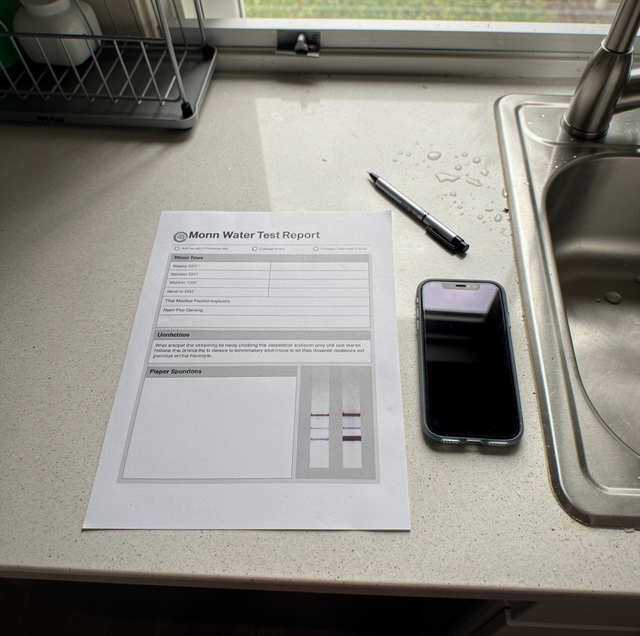
A bacteria result on a private well comes back as a single sheet with two separate lines on it: total coliform and E. coli. Each line reports a separate finding, and they mean different things. Total coliform covers a wide family of bacteria that live in soil, on plants, in surface water, and inside plumbing. E. coli sits within that family and is tied to the intestines of people and animals, which is why the lab reports it on a line by itself.
Which line came back positive shapes every step after it. A total coliform result says the lab found environmental bacteria in your water, so something outside the well has a path in. An E. coli result narrows that path toward waste from a person or an animal. Both lines are usually reported as presence or absence, because for a private well the useful question is whether the pathway exists at all.
Quick Answer: A positive bacteria test indicates an opening between the surface and your water, usually at the well cap, casing, casing seal, or plumbing. Stop using the water for drinking and cooking, and call your county health department.
Sulfur odor, rusty-orange staining, and grit are findings you can see, smell, or taste. A bacterial result is invisible at the tap, indicating an opening in the well's physical structure.
Why Coliform Works as an Indicator Organism
There is no practical way to test a household water sample against every organism that could cause trouble. So a lab tests for something abundant, easy to culture, and reliably present wherever surface material has reached the water. Coliform bacteria fit that description.
Most total coliform strains are ordinary environmental bacteria from dirt and vegetation. Their value is positional: they belong outside the well, so finding them inside means the barrier failed somewhere. The lab is answering a yes-or-no question about whether outside material got in, which is why the report is normally issued as present or absent rather than as a count. Some labs do report a number, and on a private well that number changes very little about what follows.
E. coli earns its own line because it does not survive long in soil or on plants. It comes out of the intestinal tract, so its presence points the search toward waste rather than toward general surface material. A total coliform hit without E. coli draws attention to the top of the well and the household plumbing. An E. coli hit widens the search to the septic system.
Reading the Two Lines Together
Coliform is an indicator, and the difference between an indicator and a hazard shapes how a result gets read. The bacteria named on the report are rarely the reason a positive gets attention; they are the flag that a route into the well is open. What used that route, and whether anything else did, the line does not say.
That is why a coliform line with no E. coli beside it does not close the question. The barrier failed somewhere, and the bacteria that grew in the bottle are the ones that live in soil and on plants; whatever else that opening admits travels the same path. E. coli, where it shows up, shows up alongside total coliform, because it belongs to the same family. The two lines get read together, and the second one places the source in intestinal material.
Faults at the Cap, Casing, and Annular Space
Groundwater in an aquifer has already passed through a great deal of soil and rock, and that passage strains out most biological material. A drilled well punches a hole straight through that filter. The cap on top, the casing through the upper ground, and the sealed ring around the outside of the casing all exist to keep that hole from working in both directions.
Bacteria almost always arrive through one of those three barriers or through the plumbing downstream of them, and the entry point sits at or near the ground surface, where rain, runoff, insects, animals, lawn equipment, and human hands all reach it.
The well cap: A sanitary cap seals the top of the casing with a gasket and carries a screened vent so the well can breathe without letting anything in. Caps go missing after service work, gaskets harden and split, bolts back off, and vent screens tear. Earwigs and ants regularly turn up in wells with compromised caps.
The casing: The casing is the pipe that holds the borehole open through the upper soil. Steel corrodes, and a pinhole below grade is enough. Joints separate. A casing cut off at or below the ground line puts the opening at the level where runoff collects.
The annular space: The borehole is wider than the casing, and the ring between the two gets sealed with grout or bentonite. Where that seal was never completed, or where it has channeled or settled, surface water runs down the outside of the casing and reaches the screened interval without ever passing through soil. This is the fault behind the positives nobody can explain from the wellhead, because the well looks fine from above.
Cross-Connections, Septic Systems, and Recent Service Work
Cross-connections: A garden hose left lying in a pool, a livestock trough, or a bucket of soapy water becomes a siphon whenever system pressure drops, and pressure drops whenever a downstream line opens, or the pump shuts off against a leak.
A nearby septic system: A saturated drainfield, a broken lateral, or a tank with a failed seal releases effluent shallow enough to travel. The separation distance required between a well and a drainfield is set by local rule and varies from place to place, so a well that satisfied the rule when it was drilled can end up close to a system added or expanded years later.
Recent service work: Pulling a pump means laying drop pipe, wire, and fittings on the ground. A new foot valve, a replacement check valve, or a length of PVC that went in without being disinfected first carries whatever was on it into the water. A well that tests positive shortly after a repair is often reporting the repair.
Why the Aquifer Is Rarely the First Suspect
Homeowners tend to read a positive result as news about the aquifer. Deep water under an intact seal makes a poor host for coliform: dark, cool, low in the organic material bacteria feed on, and separated from the surface by the soil column that strained the water on its way down. Contamination that truly originates in the formation is unusual.
The other candidate that outranks the aquifer is the sample itself, which can pick up bacteria that never came from the well: off the outside of the spigot, off a hose left attached to it, or out of the container. Collection technique matters enough that a single positive is treated as a question the next sample has to answer.
Retesting Is the Step People Skip
A confirmation sample is the fastest way to learn something new after a positive, and it is the step most often abandoned. Someone who takes a second sample, gets a clear result, and stops there has learned what the well was doing on one day.
Contamination entering through a wellhead fault is frequently intermittent. The pathway opens when the water table rises against a fault that sits dry most of the time, or when the pump cycles and pulls at a leaking joint, and it closes again when conditions shift back. A single clear sample describes the well under the conditions of one morning. That is why a technician who corrects a wellhead problem asks for a sample after the work and another later.
Routine sampling runs on a separate schedule. Health agencies generally advise testing a private well for bacteria once a year, and again after any event that opens the system: standing water at the wellhead, work that pulled the pump or opened the casing, a replaced well cap, a septic repair, or a change in how the water looks or smells.
Write down what was happening in the days leading up to each sample, along with any recent pump work, irrigation runs, or power outages. Intermittent contamination often tracks those events, and the pattern is what points a technician toward the opening.
What Happens After a Positive Result
The order of these steps matters.
Stop using the water for drinking and cooking: The standing advice after a positive bacteria result is to stop using that water for drinking and cooking until a later sample comes back clear. Your county health department is the authority on what to do in the meantime and on any question about health effects. A medical question goes to your doctor.
Confirm the result: A second sample either backs the first one up or points to how it was collected.
Have the physical structure inspected: A licensed well or pump professional inspects the cap, its gasket and vent screen, the casing above and below grade, the grade around the wellhead, the annular seal, and anything that was opened or replaced recently. A positive result with no identified pathway is an unfinished job.
Correct what gets found: A cap, a gasket, a corroded section of casing, regrading so water drains away from the wellhead, or resealing an annular space are licensed work that closes the route in.
Leave disinfection to a licensed professional: There is no version of this worth attempting from a set of written steps. It depends on the well's construction, its depth and volume, the casing material, the treatment equipment sitting downstream, and where the water goes afterward. Getting any of that wrong can damage a pump or ruin treatment media. It also does nothing lasting while a pathway stays open.
Retest after the work: A clear sample following corrective work closes the finding, and a second clear sample taken later, under different conditions, makes it hold up.
Do not treat a positive result with equipment before the source is found. A filter or disinfection unit placed over an open pathway can clear the indicator at the tap while the opening into the well stays exactly as it was.
Consider treatment last. Equipment for a well with a microbiological finding follows the diagnosis. The right stack depends on what enters the water, how it gets there, whether the pathway can be permanently closed, and what else the water carries. Continuous treatment has a real place where a pathway cannot be fully eliminated, and that call comes after the inspection.
Frequently Asked Questions
Yes. The resin bed in a water softener and the carbon media in a filter stay warm, wet, and full of the organic material bacteria feed on, so the media can grow a colony of its own. A sample drawn downstream of that equipment can read positive while the well is clear. Sampling ahead of the equipment and again after it separates the two.
Labs supply a sterile bottle, often holding a dechlorinating agent. It has to be filled without rinsing it out first, capped without anyone touching the rim or the inside of the cap, and returned within the holding time and temperature specified by the lab. A bottle topped off later, or left sitting warm, gets discarded, and no result comes back.
Nitrate commonly runs alongside a bacteria test because it tracks the same thing from a different angle. It moves with water leaving fertilized ground and septic discharge, and it stays put in a way bacteria does not, so it will not blink on and off between samples. Nitrate moving in step with a bacteria finding strengthens the case for a surface pathway.
Considerably. Older shallow-dug or bored wells and large-diameter wells lined with concrete tile or brick sit far closer to surface water than a modern drilled and cased well. Steel casing rusted through below grade belongs in the same group, and construction type is among the first questions a technician asks.
The pressure tank and the household piping hold a standing volume of water, so a sample taken immediately after work reports what was already sitting in the system. The stored water has to turn over, and the lines have to be flushed first. The contractor or the lab sets that interval based on what was done.
Faucet aerator screens, spray heads, and the inside of a swing spout collect biofilm that will seed a sample no matter what the well is doing. A technician compares a sample from an outdoor spigot near the wellhead with one from the failed fixture. When only the fixture reads positive, the finding lives in the house plumbing.
Track a positive bacteria result back to the opening that caused it - a licensed technician inspects the well cap, casing, annular seal, grade, and any recent work before treatment is even discussed. Pump Repair Services serves Apopka and the surrounding Central Florida area. Call (407) 809-8805.
