
Blue-Green Stains on Fixtures? Your Water Is Corroding Copper
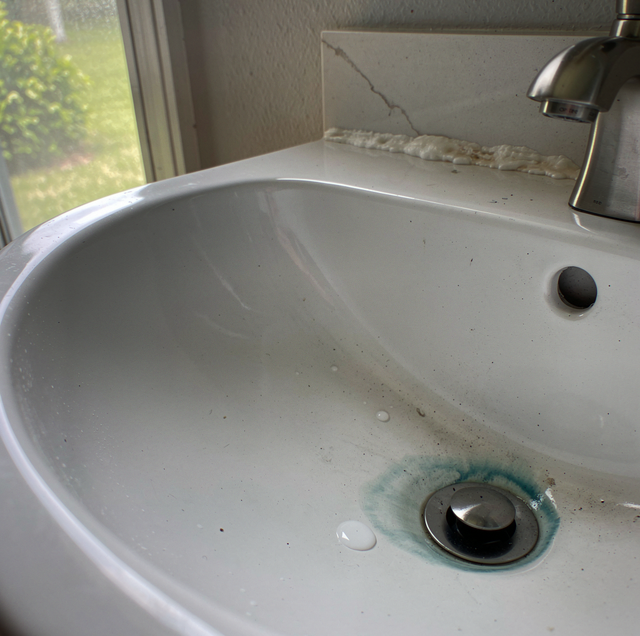
The blue-green ring around your drain is copper that came out of your own plumbing. It was not in the water that left the well. Groundwater arrives at the house carrying almost no copper, then stands in a copper tube for hours on the way to that fixture, and it leaves the tap with a trace of the pipe wall dissolved into it. Where the water evaporates or meets soap, the copper forms a blue-green film on the porcelain.
That color is evidence about your water. The well is delivering water acidic enough to strip copper's protective inner skin faster than the pipe rebuilds it, and every hour the water stands still in the line, it takes a little more.
The Stain Is Copper Leaving Your Pipes
Copper tube does not stay bare inside. Water passing through it deposits a thin internal film of copper oxide and copper carbonate, and once that film is continuous, it slows the rate at which more copper enters the water. Acidic water works against it. Hydrogen ions consume the film faster than it reforms; the bare metal underneath dissolves as a cupric ion, and the water reaching your tap carries copper it did not have at the wellhead.
You never see it in the glass, because at these concentrations dissolved copper is colorless. You see it where the water leaves. As a droplet dries on porcelain, or as water meets the alkaline residue of soap, copper comes back out of solution as basic copper carbonate and copper soaps, which are blue-green. The film builds up at the drip point under a faucet, in the seat of a tub below the showerhead, and in the ring around a drain.
Rusty-orange staining runs the opposite direction, since the metal arrives dissolved in the water from the ground and turns to rust once it meets air, which makes it a question about the aquifer and a separate diagnosis.
Why Alkalinity Matters as Much as pH
Acidity shows up as two separate numbers on a water report, and they measure different things. pH counts the hydrogen ions present at the moment of the reading. Alkalinity measures a water's capacity to absorb acid without changing the pH, and a lab reports it in milligrams per liter as calcium carbonate. A well can test at pH 6.8 and still take copper steadily, because there is little carbonate in it to hold that pH the instant the water touches metal.
The acidity itself comes from somewhere ordinary. Rain picks up carbon dioxide from the air and, to a greater extent, from the soil, forming carbonic acid. Water moving through a sandy formation with almost no carbonate to dissolve keeps that acid. Water moving through limestone dissolves calcium carbonate on the way, which neutralizes the acid and leaves the water hard and buffered, so two wells on the same road, finished at different depths, can differ completely.
The recommended pH range for drinking water is 6.5 to 8.5, with corrosion cited as the effect of the low end. That range is a non-enforceable guideline about taste, odor, and appearance, so it is a reference point you can hold your own report against. Your lab may also give a Langelier Saturation Index, where a negative value describes water undersaturated with calcium carbonate.
How Much Copper Is Reaching Your Tap?
Copper need not be present in significant quantities to mark porcelain. The recommended secondary limit for copper is 1.0 milligram per liter, with a metallic taste and blue-green staining as the effects noted above that figure. A different figure, 1.3, applies to public water systems. A result under that figure alongside a visible stain in the tub means the marks are building from repeated deposits, one drying droplet at a time, at concentrations you would never taste.
Concentration also depends on how long the water has been sitting. Water in contact with copper keeps taking up more of it until the reaction slows near equilibrium, so the first flow out of a bathroom nobody uses carries more copper than the kitchen tap you run all day. That is why the marks sit unevenly through a house. Heat pushes the reaction along, and the tub below the shower head and the hot-side fittings stain before the cold ones do.
Blue-green staining that comes back after each cleaning means copper is dissolving into water your household drinks. Have a certified lab measure copper and pH on a sample from your own tap, and take that result to your local health department.
That pattern is also your check. If the marks follow the fixtures that sit unused, the copper is being picked up inside the house. If exactly one fixture stains and the rest stay clean, look at that fixture's own brass and its supply fittings before you look at the well.
What Is at Risk Inside the Walls?
What the water removes is pipe wall. Wall thickness is specified by type, and at a half-inch nominal size, a Type L tube has 0.040 inch of wall, Type M 0.028 inch, and Type K 0.049 inch. The type is printed along the tube, so you can read yours off the pipe at the water heater.
General attack takes that wall down along its whole length, which is slow work and shows up as stains and taste long before it shows up as water. The failure you care about is the other kind. Where the protective film breaks down at one spot and does not re-form, metal is removed at that point while the rest of the pipe stays near full thickness, and the wall opens as a pinhole. It weeps before it bursts, and it turns up as a stain spreading on drywall or a ceiling.
Be careful about what the color proves. Staining establishes that copper is entering your water. It does not date a pinhole, locate one, or promise one is coming, since pitting also follows flux residue left at a joint and flow fast enough to scour the film off an elbow. Aggressive water can also pull zinc out of brass fittings, leaving a porous copper skeleton that appears as a weeping valve or a pale crust at a joint.
The Neutralizer Bed Dissolves as It Works
Calcite is crushed limestone, screened to a working size and loaded into a tank your whole house's water passes through on its way in from the well. Acidic water dissolves it. Every bit of calcium carbonate that dissolves consumes hydrogen ions and releases calcium and bicarbonate, so the pH rises and the alkalinity rises with it. The reaction stops itself once the water is saturated with calcium carbonate, which is why a calcite bed lifts pH toward neutral and no further.
How far it gets depends on contact time, so bed depth and your household's peak draw both belong in the sizing. The calcium it hands back is real hardness, and a house already close to the edge will notice it.
The media does not sit there. It leaves with the water, a little at a time, so the bed loses height and has to be topped up on a schedule that follows how many gallons pass through and how far below neutral your raw water arrives. A periodic backwash lifts and re-sorts the bed, preventing the flow from cutting channels through it. Where calcite alone cannot lift the water far enough, magnesium oxide is blended into the bed, dissolving faster and reaching higher. Reading the bed height at the tank, on a set interval, is ordinary upkeep on a filter that spends itself doing its job.
Frequently Asked Questions
A softener trades calcium and magnesium for sodium on a resin bed, and that exchange leaves pH and alkalinity where it found them. Water that went in acidic comes out acidic, so the copper keeps dissolving and your stains keep coming back. Softening and neutralizing are two jobs on two different numbers, and hard, acidic water can need both in a fixed order: neutralize first, then soften the calcium the neutralizer handed back.
Quickly enough to change the answer. Dissolved carbon dioxide escapes a sample when it meets air, and losing it raises the pH, so a bottle carried across town gives a less acidic result than the water sitting in your line. Standard lab procedure calls for the pH measurement to be made immediately for that reason. A meter used at your own tap gives a number worth having.
Dissolved copper binds to the protein in hair, and light, porous, or chemically treated hair shows it first, as a green cast ordinary shampoo will not lift. It is the same copper marking your tub, arriving in the same water, so a clarifying rinse deals with the hair while the water keeps supplying more. Mention the tint to whoever tests the water, because it points at the same chemistry.
New copper has no protective film, so a fresh installation releases more copper than the line it replaces while that layer forms over its first weeks and months in service. The effect is real, and it fades. If your water is acidic, the film never becomes continuous, and what looks like new-pipe break-in is still there a year later. Sample soon after the work and again months on.
The water heater's sacrificial anode rod, a magnesium or aluminum rod suspended in the tank to corrode ahead of the steel, corrodes faster in aggressive water, and once it is spent, the tank lining faces the water alone. Check it against the interval in your heater's own manual. Galvanized steel pipe gives up material to the same water and leaves marks of a different color.
The action level for copper in drinking water is 1.3 milligrams per liter, measured in a 1-liter first-draw sample from a cold tap that has stood unused for at least 6 hours, because copper is picked up as the water stands. That level applies to public water systems and triggers corrosion-control work by the utility; a private well sits outside it. Treat it as a reference point, and take your own result to your health department.
Get a water test at your own tap - it gives the pH, the alkalinity, and the copper figure for your line, three numbers a stain's color cannot give you and the three a neutralizer is sized against. Pump Repair Services serves Apopka and the surrounding Central Florida area. Call (407) 809-8805.
